Deutschland
 United Kingdom

- Class 100 vs ISO 5 at a glance
- Where “Class 100” came from
- Full class 100 cleanroom conversion chart
- Why 100 per cubic foot becomes 3,520 per cubic meter
- Three places the labels differ
- Air changes and airflow
- EU GMP grade A vs ISO 5
- What the walls, ceiling and doors do
- How often an ISO 5 room gets retested
- What to write in your RFQ
- FAQ
Class 100 cleanroom vs ISO 5: the short answer
A class 100 cleanroom and an ISO Class 5 cleanroom are the same cleanliness level. Both allow no more than 100 particles of 0.5 µm or larger per cubic foot of air, which ISO writes as 3,520 particles per cubic meter. “Class 100” is the old U.S. Federal Standard 209E name. “ISO 5” is the current name, from ISO 14644-1. The numbers match. The paperwork doesn’t, and that’s where buyers get caught. Whether you’re specifying, buying or auditing a class 100 cleanroom, this guide has the full conversion chart, the arithmetic behind it, three places the two labels part ways, the EU GMP grade A link, and wording you can paste into an RFQ. If you’re new to the topic, start with our guide to what a cleanroom is.| Class 100 (FS 209E) | ISO Class 5 (ISO 14644-1) | |
|---|---|---|
| Status | Cancelled by the U.S. GSA on 29 November 2001 | Current. ISO 14644-1:2015, confirmed in 2021 |
| Unit | Particles per cubic foot | Particles per cubic meter |
| Limit at ≥0.5 µm | 100 | 3,520 |
| Where you still see it | Old spec sheets, fab drawings, casual talk | Contracts, audits, new builds |
Where “Class 100” came from, and why it won’t die
Federal Standard 209E was the U.S. government’s cleanroom yardstick. It named a room by the number of 0.5 µm particles in a cubic foot of air, so a Class 100 room had 100 of them and a Class 10,000 room had 10,000. The name told you the limit, which is why people liked it. ISO 14644-1 arrived in 1999 and took over internationally. The GSA formally cancelled 209E on 29 November 2001, according to the cleanroom classification summary on Wikipedia. Twenty-five years later, semiconductor and pharma people still say “Class 100” because every legacy drawing does. Expect to keep hearing it.Full class 100 cleanroom conversion chart (FS 209E to ISO 14644-1)
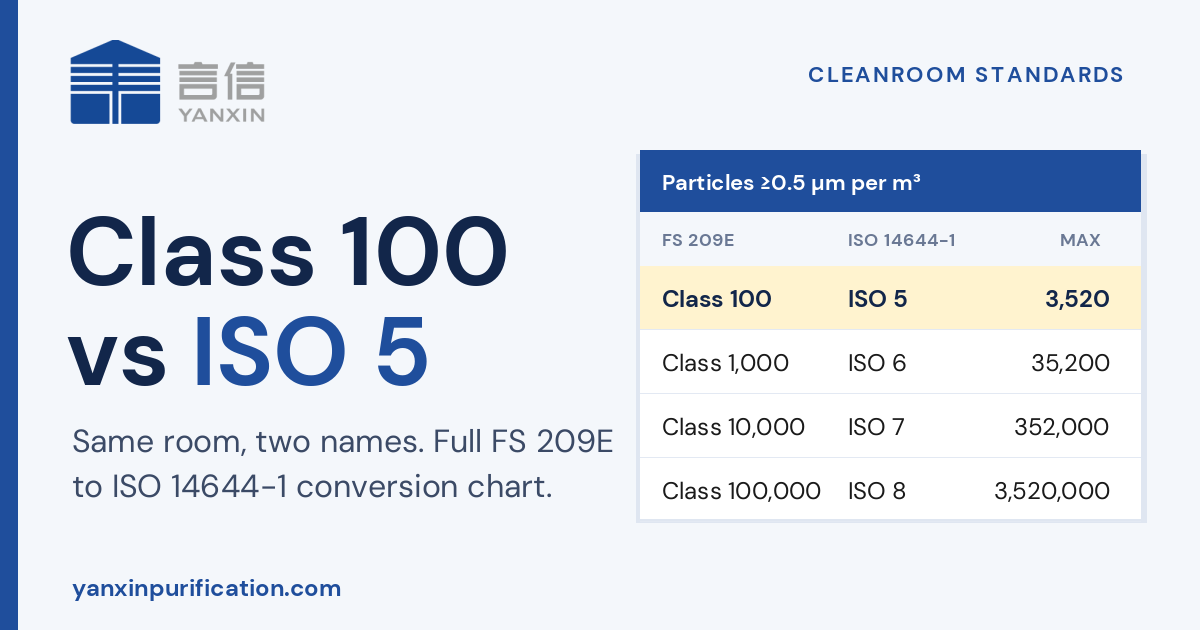
Each 209E class is ten times the one before it, and each ISO class is one step up the scale, so the mapping is clean. To see which industries run at which class, jump to matching industry to ISO class in our main cleanroom guide.| FS 209E class | ISO class | Max ≥0.5 µm per ft³ | Max ≥0.5 µm per m³ |
|---|---|---|---|
| Class 1 | ISO 3 | 1 | 35 |
| Class 10 | ISO 4 | 10 | 352 |
| Class 100 | ISO 5 | 100 | 3,520 |
| Class 1,000 | ISO 6 | 1,000 | 35,200 |
| Class 10,000 | ISO 7 | 10,000 | 352,000 |
| Class 100,000 | ISO 8 | 100,000 | 3,520,000 |
Why 100 per cubic foot becomes 3,520 per cubic meter
One cubic meter holds 35.3147 cubic feet. Multiply 100 by that and you get 3,531, not 3,520. The gap exists because ISO doesn’t convert anything. It calculates each class from a formula, Cn = 10N × (0.1 / D)2.08, where N is the class number and D is the particle size in micrometers. For N = 5 and D = 0.5, that comes to about 3,517, which the standard prints as 3,520. The 0.3% difference is why the two are called equivalent and not identical. Nobody will ever measure it, but it explains why a “converted” 209E number can look slightly off.Three places where Class 100 and ISO 5 are not interchangeable
1. ISO 5 has limits at several particle sizes. At ISO 5 the standard allows 100,000 particles per m³ at ≥0.1 µm, 23,700 at ≥0.2 µm, 10,200 at ≥0.3 µm, 3,520 at ≥0.5 µm and 832 at ≥1 µm. A buyer picks the size or sizes to test, and the report should say which. A class 100 cleanroom described by name alone leaves all of that open. “ISO 5” with no size and no occupancy state is an incomplete designation. 2. The 5 µm number is out of date in most guides. Plenty of pages still say ISO 5 allows 29 particles per m³ at ≥5 µm. That figure belongs to the 1999 edition. The 2015 edition no longer lists a 5 µm limit for ISO 5. 3. A contract that cites 209E cites a dead document. If your specification says “Class 100 per FS 209E,” the reference was cancelled in 2001. Name ISO 14644-1:2015 instead, and keep “Class 100” in brackets if your team still uses it.ISO 5 air changes: the number the standard doesn’t give
Search for ISO 5 requirements and two of the top guides quote air changes per hour: one says 240 to 600, another says 300 to 480. Both can’t be the number. Neither comes from ISO 14644-1, which defines classes by particle counts and stays silent on how you get there. The one airflow figure worth trusting comes from the EU’s own text. Section 4.30 of the revised EU GMP Annex 1 says unidirectional airflow should be a homogeneous 0.36 to 0.54 m/s at the working position, as a guidance value, unless the contamination control strategy justifies something else. That’s a velocity at the point where product is exposed, not a room-wide air change rate. You prove it with airflow visualization and a particle count, not with a spreadsheet.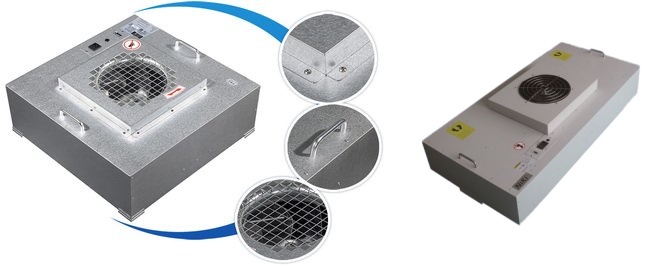
Class 100 in pharma: EU GMP grade A, and why grade B trips people up
Pharmaceutical buyers rarely say “Class 100.” They say grade A. The revised Annex 1 for sterile manufacturing, which took effect on 25 August 2023, sets total particle limits by grade and by state. Annex 1 also says classification should be carried out both “at rest” and “in operation.”| EU GMP grade | ≥0.5 µm per m³, at rest | ≥0.5 µm per m³, in operation | ISO class (at rest / in operation) |
|---|---|---|---|
| A | 3,520 | 3,520 | ISO 5 / ISO 5 |
| B | 3,520 | 352,000 | ISO 5 / ISO 7 |
| C | 352,000 | 3,520,000 | ISO 7 / ISO 8 |
| D | 3,520,000 | Not predetermined | ISO 8 / set by the manufacturer |
What the walls, ceiling and doors do for an ISO 5 room
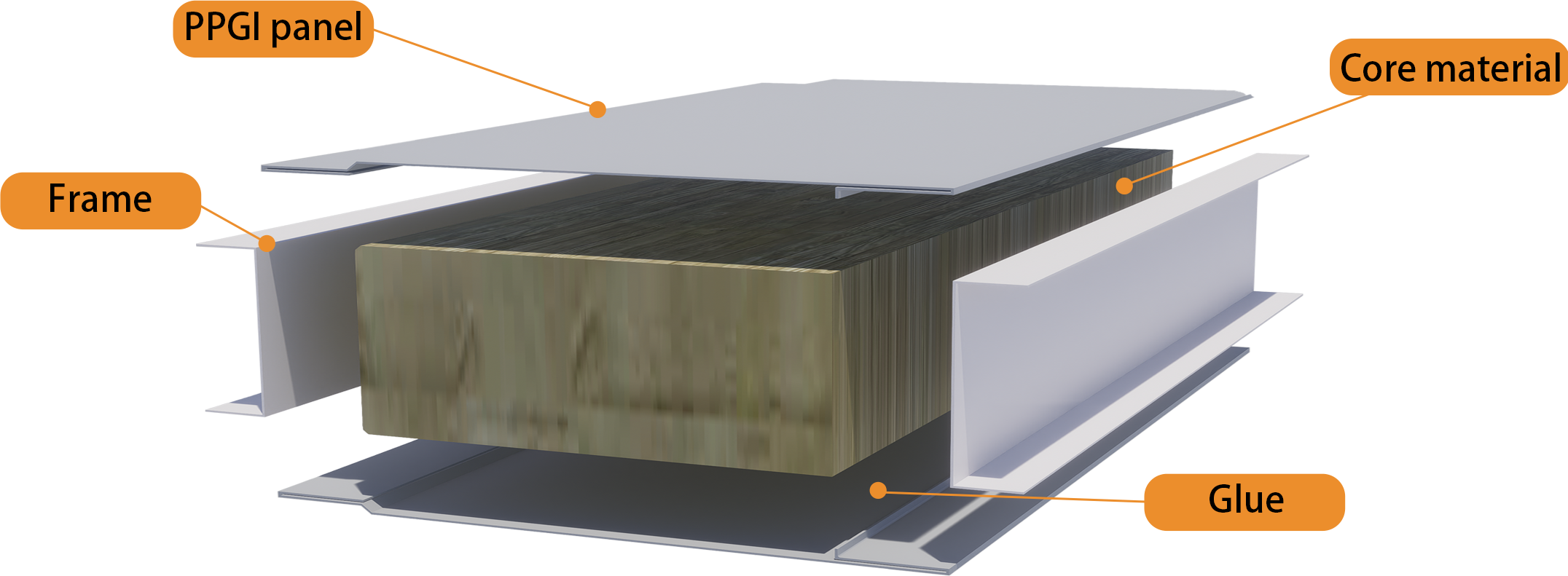
If you’re building a class 100 cleanroom, be clear about one thing: a wall panel doesn’t certify a room. The class is proven by counting particles in the finished room. What the building envelope controls is whether the room can hold the class once it’s running: leakage, shedding, cleanability, and pressure. That’s the job of the hardwall system. Yanxin’s cleanroom wall panels come in 50, 75 and 100 mm thicknesses, 980 or 1,180 mm wide and up to 6,000 mm long, with 0.4 to 0.8 mm face sheets in PPGI, aluminum-magnesium-manganese alloy or stainless steel. Cores include rock wool, magnesium oxide, honeycomb and PU. The modular cleanroom range uses 80 × 80 × 2.0 mm aluminum frames, and Yanxin lists clean booths from ISO 5 upward.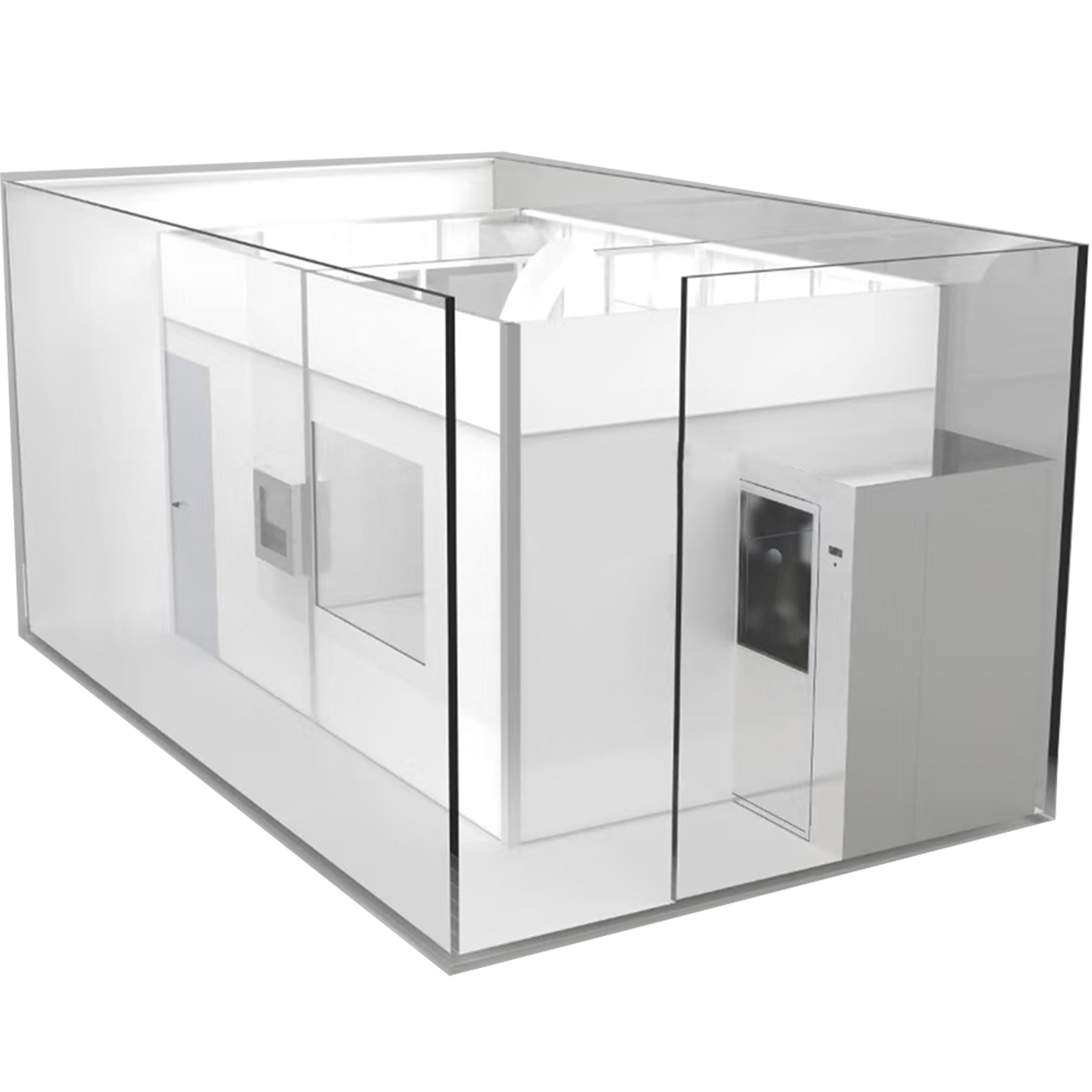
How often an ISO 5 room gets retested
ISO 14644-2:2015 suggests a maximum interval of 6 months between particle count tests for rooms at ISO 5 or cleaner, and 12 months for ISO 6 and above, as summarized by Connect 2 Cleanrooms. A documented risk assessment can move those dates either way. Pharma sites usually add continuous monitoring on top, so the semiannual test becomes a confirmation and not a surprise.What to write in your RFQ
Ordering a class 100 cleanroom by that name alone causes quote disputes. Say what you’re measuring, when, and by whom. Something like this:Cleanroom classification: ISO Class 5 (formerly FS 209E Class 100) per ISO 14644-1:2015, ≥0.5 µm, maximum 3,520 particles/m³, in operation. Classification test by an independent party on the finished room, report included at handover.Add the particle sizes you care about, the occupancy state (as built, at rest or in operation), room dimensions, and any pharma grade (A, B, C or D) the room has to meet. That’s enough for a supplier to price against. If you’d like a second pair of eyes on a spec, send us the drawing and target class, and our team will tell you what the room needs and what it doesn’t.
Frequently asked questions
What is a class 100 cleanroom?
A room where each cubic foot of air holds no more than 100 particles of 0.5 µm or larger. Under today’s ISO 14644-1 it is called ISO Class 5.
Is Class 100 the same as ISO 5?
Yes, for practical purposes. Class 100 allows 100 particles of ≥0.5 µm per cubic foot, and ISO 5 allows 3,520 per cubic meter, which is the same limit within about 0.3%. The ISO class also sets limits at other particle sizes.
What is Class 10,000 in ISO?
ISO 7, with a limit of 352,000 particles of ≥0.5 µm per cubic meter.
What is a Class 1,000 cleanroom in ISO terms?
ISO 6, with a limit of 35,200 particles of ≥0.5 µm per cubic meter.
Is FS 209E still valid?
No. The U.S. General Services Administration cancelled it on 29 November 2001. People still use its class names, but contracts and audits should cite ISO 14644-1:2015.
Is ISO 5 the same as EU GMP grade A?
Grade A requires ISO 5 both at rest and in operation. Grade B needs ISO 5 only at rest and ISO 7 in operation, so an ISO 5 result alone does not tell you which grade a room meets.
How often should an ISO 5 cleanroom be recertified?
ISO 14644-2:2015 suggests every 6 months at most for ISO 5 and cleaner, with a risk assessment allowed to adjust that.